Low slope and no slope
Commercial and flat roofing
Residential and commercial roofing including flat roof, asphalt, and TPO roofing, and new construction roofing. Free inspections and free estimates on commercial buildings too.
Chapter 01
Ponding, seams, and the flat-roof failure map
A low-slope roof does not shed water, it drains it, and everything that goes wrong follows from that. Water that cannot get to a drain within a couple of days sits, and standing water finds every weakness the membrane has.
Failures cluster in three places. Seams, where two sheets are joined and the bond was cold, contaminated or under-rolled. Penetrations, where curbs, vents, drains and every rooftop unit interrupt the field and rely on flashing details rather than the sheet itself. And edges, where the membrane is terminated and where wind gets its first grip.
Ponding accelerates all three. It concentrates ultraviolet damage, holds silt that abrades the sheet, adds real weight over a deck that was designed for drainage rather than storage, and in winter it freezes and works the seams open. So the inspection starts at the drains and the low spots, not in the middle of the field.
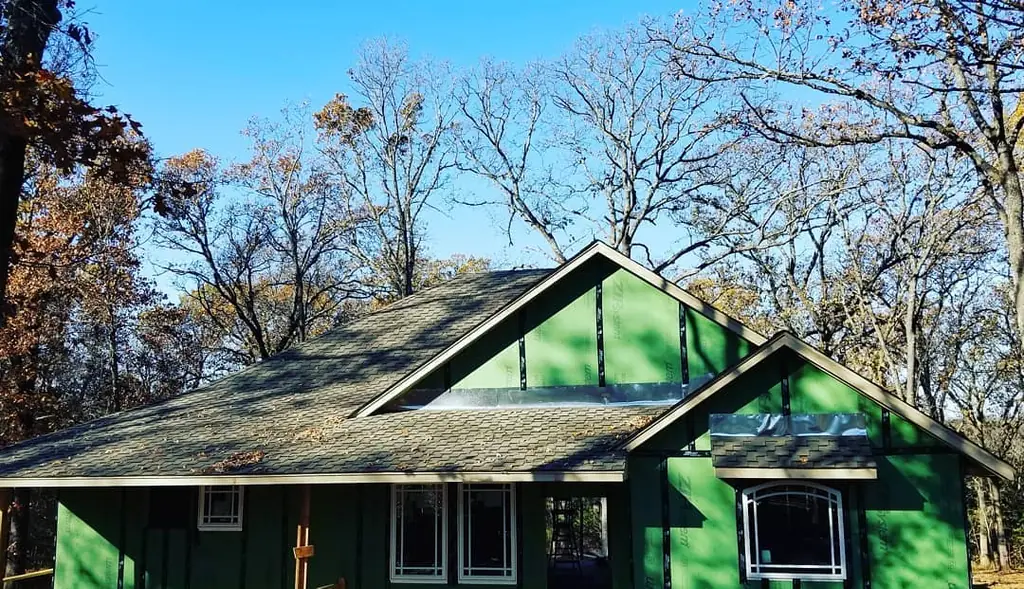
Roof planes, edge metal and flashing detail on an Oklahoma City building
TPO, modified bitumen, and picking by building rather than by habit
TPO is a single-ply thermoplastic membrane, heat-welded at the seams rather than glued, which gives a seam that is effectively as strong as the sheet. It is usually white, so it reflects a serious amount of heat load off a building that is running rooftop air conditioning through an Oklahoma summer.
Modified bitumen is the asphalt-based alternative, installed in torched or self-adhered plies. It is heavier, more forgiving of foot traffic, and often the better answer on a roof with a lot of maintenance access, service crews, or equipment that gets walked to regularly.
The choice comes down to the building rather than a preference. How much rooftop equipment is there, how much traffic does the roof take, what is the deck, what is the drainage actually like, and does the cooling load make a reflective surface worth real money. We will walk it and tell you which one fits, including when the honest answer is a repair and a maintenance plan rather than a tear-off.
Chapter 03
Working around a business that has to stay open
The roof is not the hard part on most commercial jobs. The logistics are. You have staff, customers, deliveries, and equipment inside that does not tolerate dust or a leak in the wrong week.
So we stage it. The roof gets sectioned so that no area is ever left open overnight, and each day's work is dried in before the crew leaves regardless of where that lands in the schedule. Materials and the dumpster get placed where they do not take your parking or block a fire lane, and we agree the loading route before anything arrives.
Noise and access get scheduled around your hours where the work allows it. Tear-off over an occupied space is the loudest part of the process and it is worth planning around rather than apologizing for afterwards. Emergency services are available if a storm opens the building up mid-week.
Flat roof, asphalt and TPO roofing. New construction roofing. Fully insured with workers compensation and general liability insurance. OK CIB #80002439.